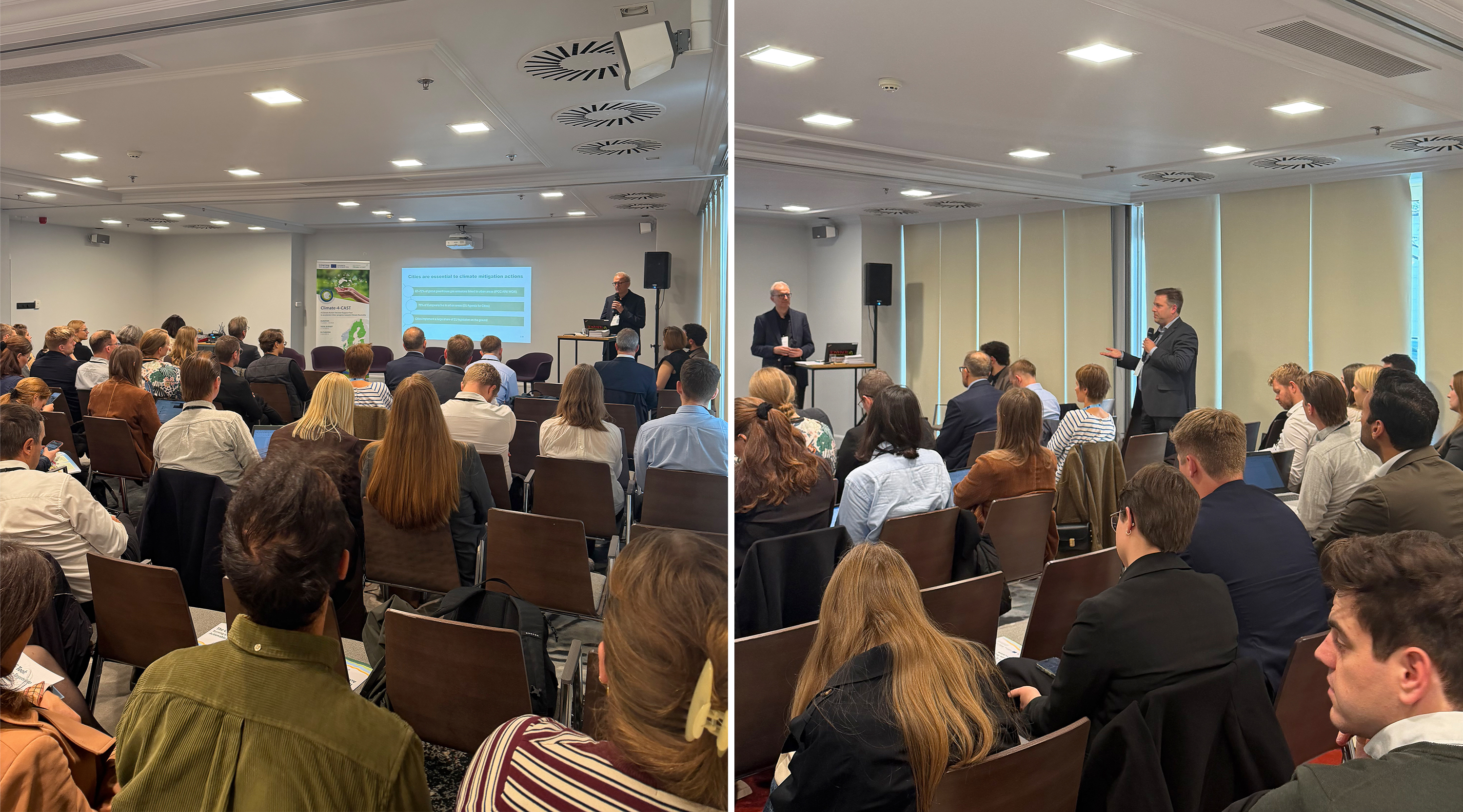
Organised as a partner event of the EU Week of Regions and Cities, and the final meeting of the Climate-4-CAST project co-funded by the Interreg Baltic Sea Region Programme, the Summit focused on the role of climate budgeting in helping cities align their financial decisions with climate neutrality objectives.
Around 50 participants shared experiences and reflected on practical solutions for including climate considerations in budgeting and governance. The discussion touched upon common challenges, such as how to manage competing priorities, limited resources and political realities. Most participants represented European local and regional authorities, alongside representatives from the European Commission’s DG REGIO, the Interreg Baltic Sea Region Programme, and the city networks Eurocities, ICLEI and UBC.
The main highlight of the Summit was a high-level panel discussion that addressed some of the most pressing questions that the local decision-makers are facing today: How can cities invest in ambitious climate action when some measures may increase costs for residents? How can climate investments be justified alongside urgent social needs? And how should municipalities prioritise limited resources to achieve the greatest impact?
The panel featured an outstanding group of leaders and experts:
- Gunārs Ansiņš, Mayor of Liepāja, Latvia
- Elina Rantanen, Deputy Mayor of Turku, Finland and Vice-President of UBC
- Sylwia Słomiak, Co-Head of Climate & Environment at the Eurocities network
- Benno Hain, Head of Advisory Unit Climate Neutrality at the Hamburg Ministry of Environment, Climate, Energy and Agriculture, Germany
- Valdis Ratniks, Energy Manager from the Riga Energy Agency, Latvia
- The discussion was moderated by Jörg Knieling, Professor at the HafenCity University Hamburg.
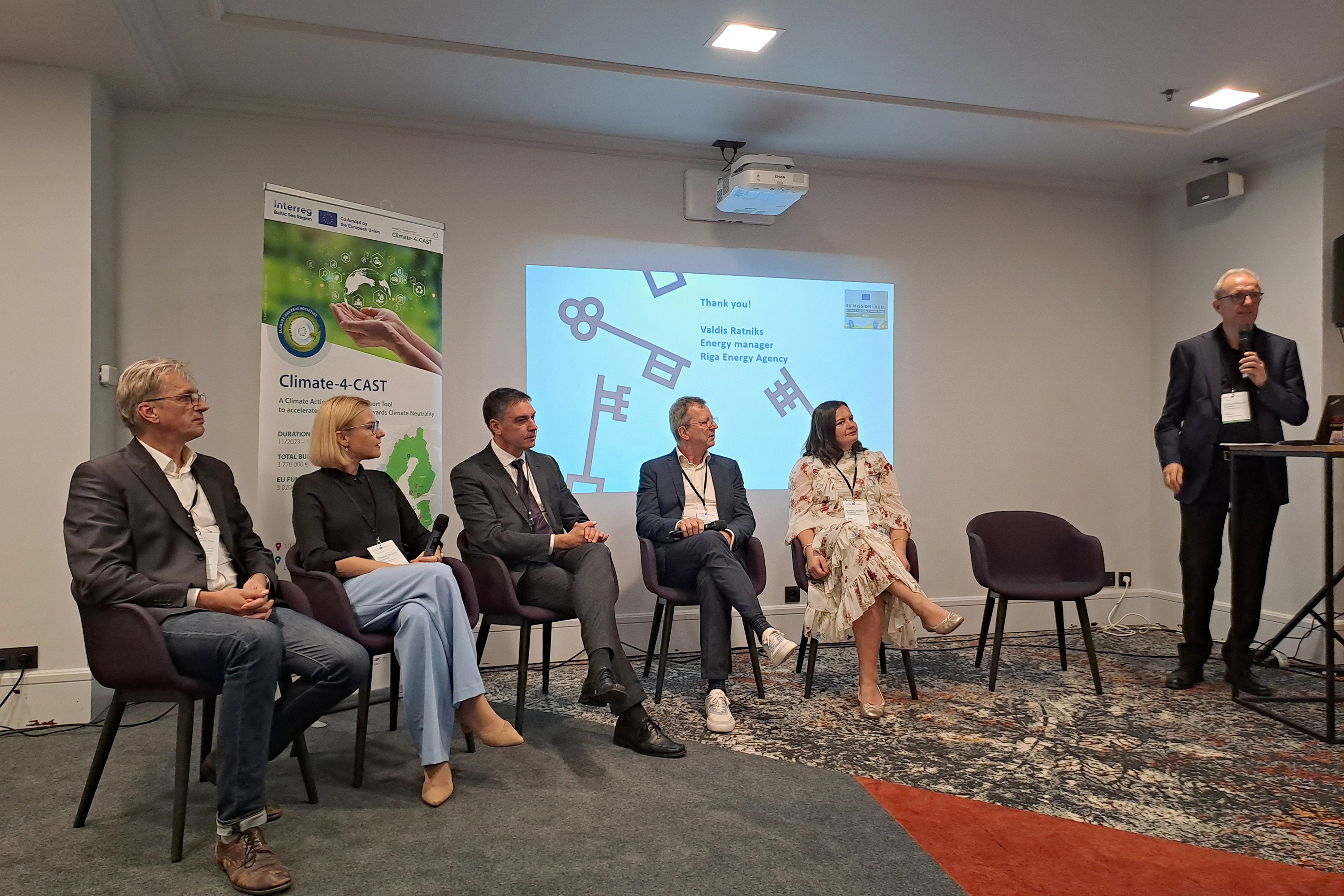
Panel discussion. Photo by Inga Pelša.
The lively panel brought climate goals and figures into focus through practical examples that highlighted their relevance to people’s everyday lives. Panelists discussed how to secure funds for implementation of climate activities and pointed out that sometimes cities can attract substantial investment without explicitly linking it to climate work. Climate investments can thus feel more relatable if framed through tangible benefits, like creating more walkable and greener cities or ensuring more affordable energy and just transition. Cooperation at different levels, including citizen engagement and collaboration between cities, also supports this process. Even healthy rivalry among cities in the same country can encourage positive competition and accelerate progress towards achieving the climate goals.
Beyond the panel, the Summit showcased one practical solution to support climate budgeting, the newly launched CADS Tool for climate-informed decision-making. Participants discussed what effective climate governance looks like in practice, how the EU climate policies can transparently be translated into local work, and how cities can better communicate climate priorities to both their political leadership as well as residents.
The summit also marked an important milestone for the Climate-4-CAST project. Over the past year, the project has supported cities and regions in building their capacities in the climate budget training course. Through transfer activities led by the Union of the Baltic Cities Sustainable Cities Commission, the Summit’s main organizer, representatives of more than 200 local and regional authorities and stakeholders learned how to implement various steps of the climate budgeting process, helping to obtain the skills and knowledge for climate-conscious decision-making across the Baltic Sea Region and beyond.
