Getting started with climate budgeting
Climate Budget Training Course: Module 1
Conference (1 October 2025)
How can climate budgeting support cities' directions for climate neutrality, what are different approaches to it, and where to begin? In the Module 1, we opened the discussion on urban climate governance and explored various approaches to climate budgeting through practical examples from Copenhagen, Bergen, Turku, Kraków, and Espoo. The Module 1 was organised as the Climate Budget Summit #1 and it was followed further with the recorded UBC TALKS webinar.
Webinar (2 December 2025)
On 2 December 2025, we explored how climate budgeting can help cities reach their climate neutrality goals. International experts presented best practices from leading BSR cities, a flexible tool for comprehensive calculations, and an invitation to the training course.
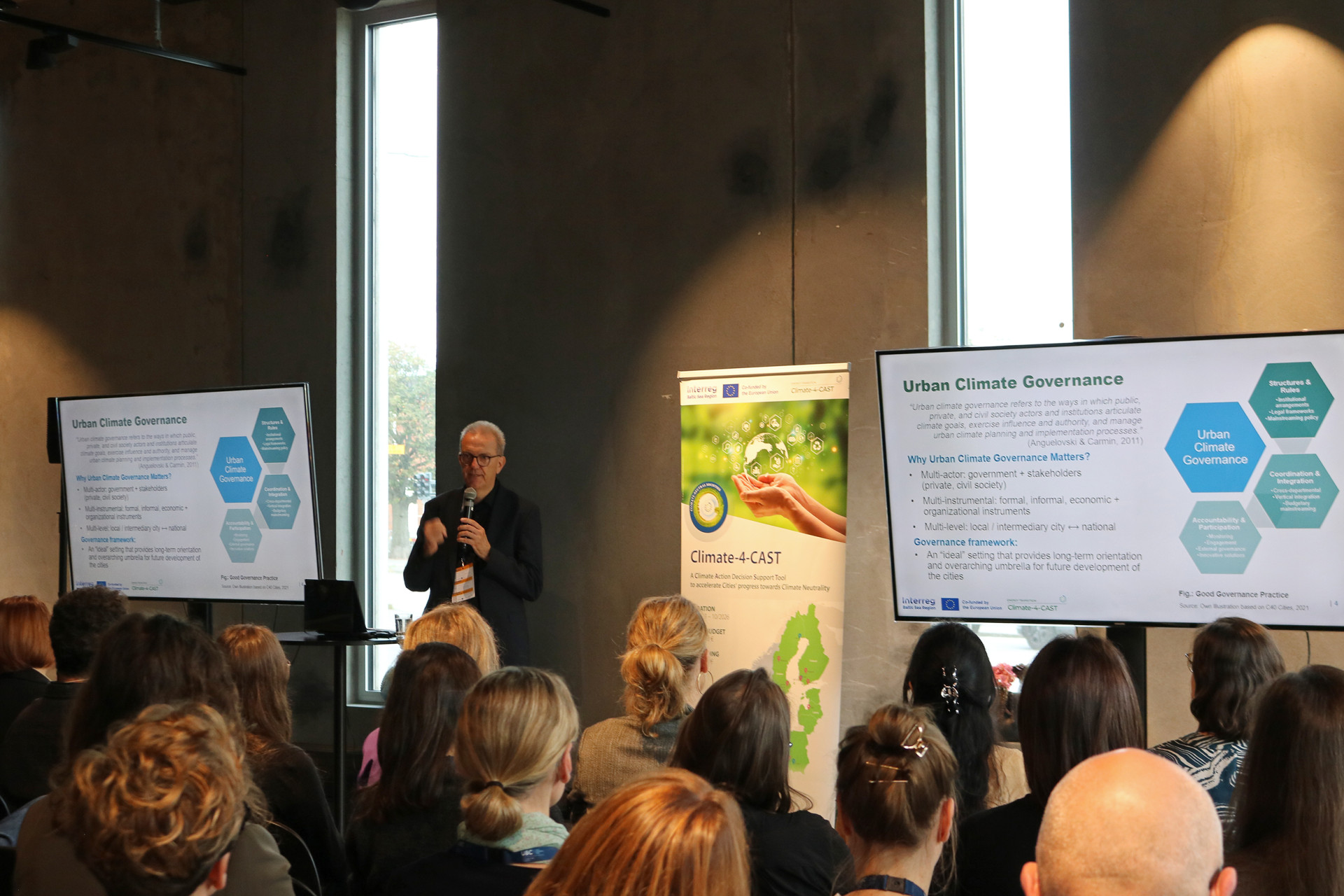
The context to the webinar was introduced by Mariia Andreeva, UBC Sustainable Cities Commission, and Donald Alimi, HafenCity University Hamburg. Then, Jörg Knieling from HafenCity University Hamburg delivered a presentation on urban climate governance. Two city cases were presented sharing climate budgeting experiences in Espoo (Mia Johansson) and Aarhus (Mads Bæk Pedersen and Amalie Ellegaard Møller). Then, Michael Mechenich, Kausal Ltd. introduced the Climate Action Decision Support (CADS) Tool for climate forecasting and budgeting, and Olena Zinchuk, UBC SCC, finished with the invitation for cities to join the climate budget training programme offered by the Climate-4-CAST project.
UBC TALKS about climate budget
Overview of Module 1 (webinar)
Module 1 focused on how climate budgeting can support cities in reaching climate neutrality goals and strengthen urban climate governance. Jörg Knieling from HafenCity University Hamburg highlighted the importance of cities as key actors in climate governance and emphasized that climate budgeting should be understood as part of a broader governance framework involving different actors, instruments, and decision-making levels.
City examples from Espoo and Aarhus demonstrated practical approaches to integrating climate budgeting into municipal planning processes. Mia Johansson presented Espoo’s climate budget as part of the city’s ordinary budgeting process supporting its climate-neutrality target for 2030, while representatives from Aarhus focused on realistic emission reduction scenarios and transparent decision-making. The module also introduced the Climate Action Decision Support (CADS) Tool, presented by Michael Mechenich from Kausal Ltd., which helps cities visualize emissions, compare action scenarios, and align spending with climate targets.