The training brings together the expertise of the project partners, the Union of the Baltic Cities Sustainable Cities Commission (UBC SCC), the University of Gdańsk, the Institute of Baltic Studies, and UBC member cities of Turku, Gdynia, Cēsis, Greifswald, Panevėžys, and Gävle. The training will be supported by the JSC Gaučė ir Ko (Lithuania), with extensive experience in delivering SUMP capacity-building through JASPERS and other European initiatives, and other selected experts.
Whether you’re just starting your SUMP journey or looking to sharpen your skills, this programme offers practical tools, peer learning, and expert insights to help you make a real impact. The training is open to anyone, with a particular focus on city representatives, planners and mobility experts from the Baltic Sea Region who want to enhance their skills, broaden their knowledge, and exchange experiences through good practices in their local context. Participation is free of charge.
Five modules spanning from January to May 2026
The training consists of five modules, each combining an introductory webinar and an engaging workshop for discussion, exchange and practical application. The online sessions will feature real-life examples from the SUMPs for BSR partner cities alongside cases from other European cities.
Module 1: Getting started with the process and its basic principles
Webinar: 14 January 2026 09:00 CET | Workshop: 21 January 2026 CET 09:00 CET
The opening module helps cities get started with the SUMP process, explaining its key steps and how it differs from traditional transport planning. Participants will explore how SUMPs contribute to climate-neutrality goals and learn about requirements under the revised TEN-T Regulation for urban nodes linking to the concept of Functional Urban Areas. The workshop will offer peer exchange on cross-sectoral coordination and stakeholder recognition.
Module 2: Setting up a monitoring and evaluation framework and defining indicators
Webinar: 4 February 2026 09:00 CET | Workshop: 11 February 2026 09:00 CET
This module highlights the importance of monitoring and evaluation (M&E) in mobility planning and presents a structured approach to building local M&E plans using tools developed within the SUMPs for BSR project. Participants will learn how to select meaningful indicators, align them with European standards, and establish data-driven processes for mobility planning and decision-making.
Module 3: Collection of data for active modes
Webinar: 4 March 2026 09:00 CET | Workshop: 18 March 2026 09:00 CET
Focusing on walking and cycling data, this module introduces practical methods for collecting and analysing active mobility data. Cities will discover how to combine on-the-ground data with smart technologies, involve citizens in the process, and communicate findings effectively to decision-makers and stakeholders to support evidence-based policies.
Module 4: Experimenting with potential mobility solutions to promote active modes
Webinar: 22 April 2026 09:00 CEST | Workshop: 29 April 2026 09:00 CEST
Small-scale experiments can be a powerful tool for transforming mobility. This module guides participants through the process of planning, implementing, and learning from pilot projects – from testing temporary measures to evaluating their impact and scaling successful solutions. Cities will share their experiences of designing pilots for walking and cycling.
Module 5: Engaging stakeholders in planning mobility measures and SUMP
Webinar: 13 May 2026 09:00 CEST | Workshop: 27 May 2026 09:00 CEST
This module focuses on effective stakeholder and citizen engagement throughout the SUMP process. Participants will learn how to map and involve key actors, secure political support, and apply engagement techniques to ensure ownership and commitment. The sessions will explore tools, examples, and best practices for building lasting collaboration among diverse stakeholders.
Cities interested in accelerating their transition towards sustainable and inclusive mobility are warmly invited to join the training series. Sign up here.
SUMP Clinic: Tailored support for ten selected cities
In addition to the open training package, the SUMP Clinic will offer personalised one-on-one support to ten selected cities from the Baltic Sea Region and Europe. The SUMP Clinic is designed to help small and mid-sized cities either start their SUMP journey or strengthen existing plans through targeted guidance.
Each selected city will benefit from two individual online consultation sessions with SUMP experts Dr Kristina Gaučė and Monika Parafinaitytė-Rae from Gaučė ir Ko. During these sessions, experts will assess local challenges, provide tailored examples, and prepare a personalised roadmap with practical recommendations for each city.
Applications are open to cities from Europe, with priority given to smaller UBC member cities and cities from Baltic Sea Region countries (Denmark, Estonia, Finland, Germany, Latvia, Lithuania, Poland, and Sweden), those currently without a SUMP, working on their first SUMP or facing implementation challenges.
Application period closes: 30 January 2026 |
Announcement of selected cities: 16 February 2026.
For more information on the SUMP Clinic, see here
Towards a long-term impact
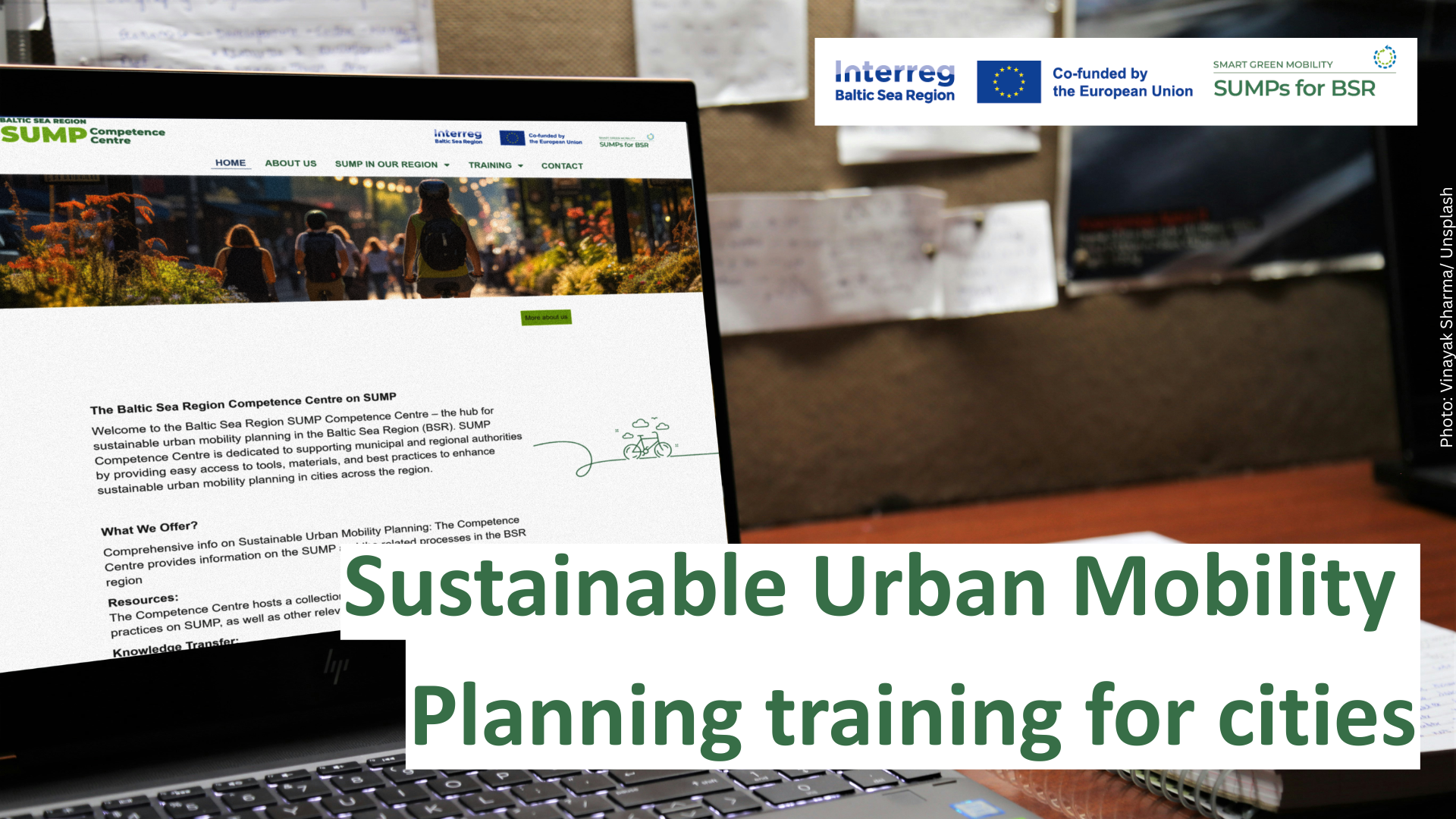
To ensure that all project outputs and materials are easily accessible and transferable to local authorities across the region, the SUMPs for BSR project is developing the Baltic Sea Region SUMP Competence Centre — a well-established and recognised platform serving as the regional hub for Sustainable Urban Mobility Plans (SUMPs).
The renewed Competence Centre will become a user-friendly, attractive, and comprehensive platform hosting all project outcomes, guidance materials, training materials and tools, as well as other SUMP-related resources relevant for cities in the Baltic Sea Region. It will act as the main hub for knowledge transfer, supporting municipalities that are initiating or improving their SUMP processes, and ensuring the long-term dissemination and uptake of project results.