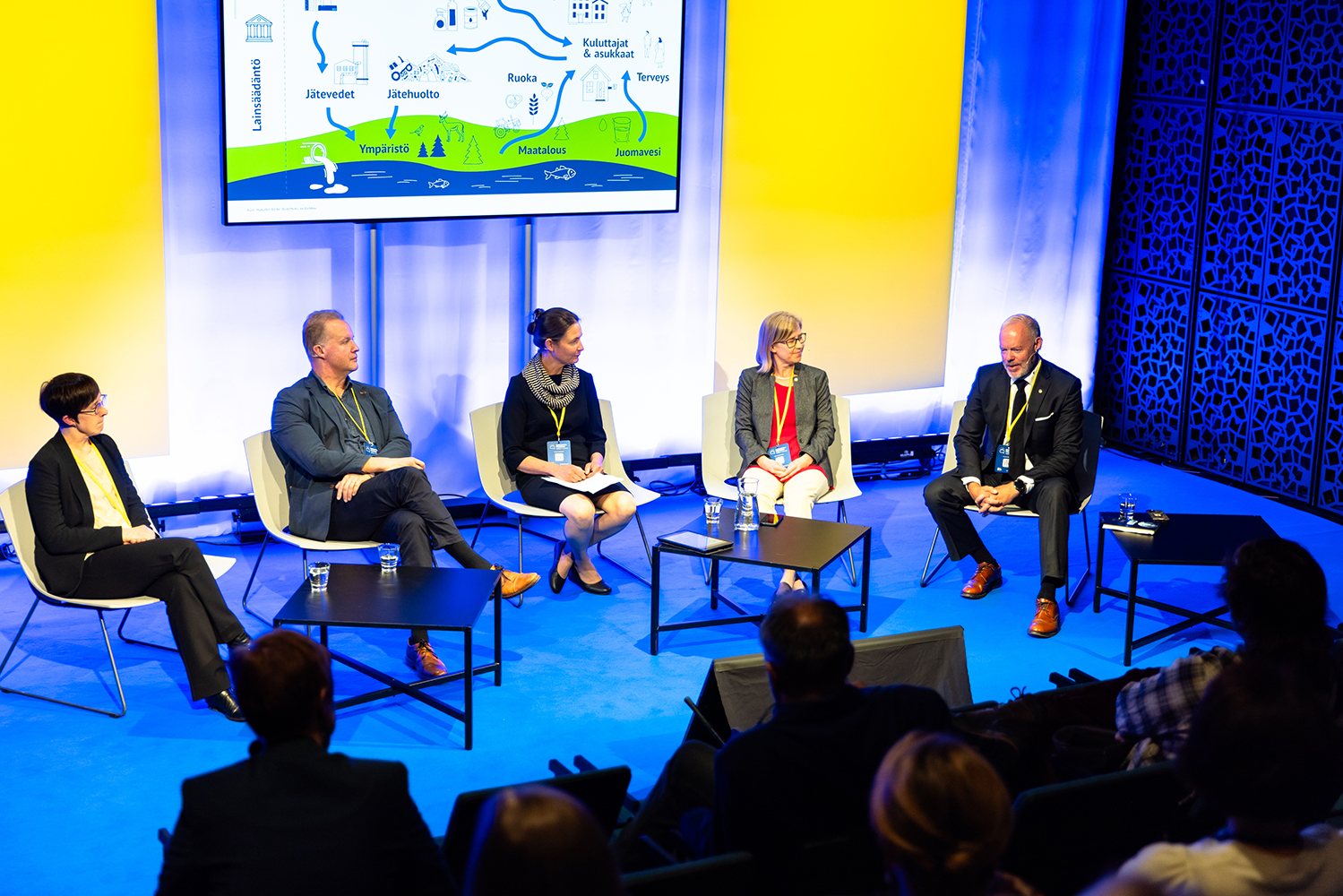
Our UBC Sustainable Cities Commission teamed up with the Turku University of Applied Sciences in organising a joint session, building on the research, piloting and data findings within the EMPEREST and NonHazCity3 projects. The objective of the panel was to explore how the harmful effects of hazardous substances on nature, people, and the circular economy can be minimized.
Researcher Piia Leskinen from the Turku University of Applied Sciences moderated the discussion of four panelists:
- Pauli Aalto-Setälä, Member of the Finnish Parliament;
- Lotta Ruokanen, Professional Secretary at HELCOM;
- Petri Tuominen, CEO of Jyväskylä Region wastewater treatment plant;
- Laura Walin, Head of Unit of Environmental Protection at the City of Helsinki.
The variety of sectors the speakers represented – research, policy-making, intergovernmental authority, wastewater treatment and local authority – built a multifaceted approach to the problem and its solutions.
According to the HELCOM’s latest holistic assessment report, hazardous substances are an even more serious threat to the Baltic Sea ecosystem than eutrophication. And these substances are seen everywhere: in the EMPEREST project, TUAS research team has found out that 67 stormwater and surface water samples out of 70 in Turku region contained varied concentrations of PFAS compounds that were banned already in 2009.
Legislation is one of the key solutions to the problem of toxic chemicals, however, as new chemicals are developed all the time, the existing regulation is not necessarily sufficient. Legislation needs to adapt to the continuous and rapid evolution of the chemical industry, and it requires more effective national implementation and monitoring of the effects.
The removal of harmful chemicals released in the environment is possible at the wastewater treatment plants – and part of it is already reflected in the recast Urban Wastewater Treatment Directive (UWWTD). UWWTD requirements are justified and could be financially reasonable for the public sector if the polluters, especially cosmetics and pharmaceutical industries, take part in the costs according to the extended producer responsibility principle.
Many of the speakers underlined prevention measures and the responsibility of the markets in the elimination of hazardous substances. Cities have in fact a lot of power to influence the market. E.g. the City of Helsinki, as the biggest public buyer in Finland, wants to include chemicals as a criterion to their procurement assessments. Environmental sustainability must become an even stronger competitive advantage – and legislation can be used to advocate such market transition.
Video: Turku University of Applied Sciences / Christian Lairikko
Cover photo by Linda Svarfvar